“Educate for the Future, Not the Past” – Dr. Kingsley Agyemang Charts Vision for 21st-Century African Classroom

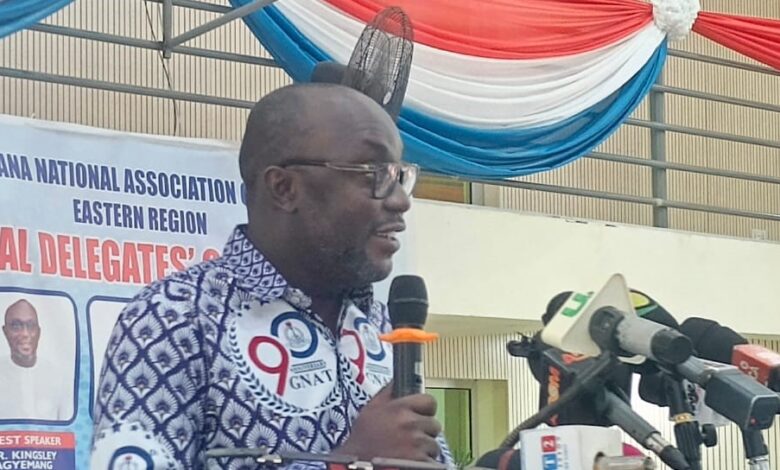
“We cannot teach tomorrow’s citizens with yesterday’s tools and expect them to outperform the world.” With these words, Hon. Dr. Kingsley Agyemang, Member of Parliament for Abuakwa South and Registrar of the Ghana Scholarships Secretariat, delivered a bold and sweeping call for Ghana’s education system to be redesigned to meet the demands of the 21st century.
Addressing educators at the 7th Quadrennial (54th) GNAT Regional Delegates’ Conference at the Kibi College of Education on Tuesday, Dr. Agyemang painted a vivid picture of the future — one where Ghanaian children are not merely equipped for exams, but empowered to innovate, create, and lead on the global stage.
“Education must move from preparing for jobs to preparing for global opportunity,” he said. “An 18-year-old in Ho must be able to compete with her counterpart in Helsinki.”
A Century of Digital Disruption and Opportunity
Dr. Agyemang warned that artificial intelligence, automation, and machine learning are no longer distant technologies but active forces reshaping sectors from health and agriculture to banking and even education. These tools, he said, are not just replacing manual labour but beginning to rival cognitive work—tasks once thought to be secure.
“In this digital age, literacy must include fluency in code,” he said, advocating for students to not only know how to count, but to also know how to code. “We must prepare learners not just for local employment, but for global relevance.”
A New Kind of African
In a powerful reflection on the identity of the 21st-century African, Dr. Agyemang called for a new educational mission—one that produces learners who are:
- Technologically empowered: able to use and create digital tools.
- Entrepreneurial in mindset: seeing problems as opportunities for innovation.
- Culturally grounded but globally competent: proud of their heritage yet capable of navigating the world.
- Ethically sound and emotionally intelligent: leaders with integrity and empathy.
“The African fit for this century must be able to write software in Python and recite the proverbs of their people. That is not a contradiction. That is completeness,” he stressed.
Vision of a Transformed Classroom
The highlight of his speech was a compelling vision of a reimagined classroom in rural Ghana: a modest school where pupils interact with digital simulations, receive real-time feedback, and are supported by AI that identifies learning gaps and suggests solutions. Teachers in this future aren’t isolated but are part of a continental community, collaborating with peers from across Africa.
“In this future, a teacher in Ghana is no longer confined to their district. They are part of a vibrant network sharing ideas with educators in Rwanda, Egypt, and South Africa,” Dr. Agyemang declared.
Call to Action for National Alignment
The MP acknowledged progress made—such as the Free SHS policy, TVET revitalisation, and gains in basic education—but cautioned against complacency. “Beyond the statistics, there remains systemic underperformance,” he said. “What is lacking is alignment—between what we teach and what the world demands, between what we fund and what we claim to value.”
Quoting Nobel Laureate Prof. Amartya Sen, he concluded: “Education is not just about literacy or numeracy. It is about widening our choices, enhancing our freedoms, and enabling people to lead lives they have reason to value.”
The Teacher as a Nation-Builder
He reminded educators of their indispensable role. “When you stand in your classroom tomorrow, remember: you are not just teaching pupils to pass exams. You are moulding the African who will shape this century.”
Dr. Agyemang’s call, both urgent and inspirational, was met with applause and standing ovations, as delegates acknowledged the truth at the heart of his message: the African child is not incapable, the African teacher is not inadequate, and the future is not out of reach—but it must be designed.