Starting on 28 December 2025, as the world anticipated the midnight fireworks in the days ahead, Iran’s national currency took a hit. This was the result of renewed and intensified UN sanctions restored on Iran following the breakdown of negotiations between the Islamic Republic and the United States over the former’s nuclear programme.
In the wake of this development, traders and businesspeople—who have legitimate concerns and constitutionally guaranteed and protected rights to protest under the Constitution of the Islamic Republic—took to the streets to voice their grievances and to demand relief from the hardships inflicted on the people by the weakening of the national currency.
These were legitimate gatherings—one might even say noble gatherings—that called for reasonable economic relief, to which the government responded positively.
First, the President of the Islamic Republic openly acknowledged the right of citizens to peaceful assembly and further agreed with the protesters that the government, in one way or another, must bear part of the responsibility for the worsening economic situation. He offered to engage in talks with protest leaders to find ways and means of addressing their grievances.
“If people have a concern, we will hear them. It is our duty to hear them and solve their problems.”
The Leader of the Islamic Revolution, Ayatollah Khamenei, also echoed the words of the President.
These peaceful protests, however, were subsequently hijacked by rioters and certain opposition elements who were allegedly working in collaboration with the Israeli Mossad and the CIA to cause chaos and disruption in the country. Using the protests as a pretext, they sought to push for the overthrow of the Iranian government—an episode that came on the heels of the abduction of the President of Venezuela by the United States.
In the course of these riots, public property was destroyed, religious centres were attacked, and security personnel were killed.
CCTV footage circulating widely also showed armed elements attacking both civilians and government forces with automatic weapons, explosives, and other arms.
In this context, the President drew a clear distinction between protesters and rioters. He emphasized that rioters were acting against society and in the interests of hostile foreign states, whereas protesters are exercising their constitutional right to peaceful assembly:
“Our highest duty is not to allow rioters to disrupt society.”
“Rioters are not protesters. We hear the protesters and have made every effort to solve their problems.”
Foreign Minister Sayyid Abbas Araghchi also stated that intercepted communications revealed that the rioters were being directed from abroad to target both protesters and security forces, noting that “terrorist elements had infiltrated the crowds of protesters and targeted security forces and demonstrators.”
The violent takeover of the protests by these rioters prompted a vigilant response from both the people and the security forces of the Islamic Republic of Iran in order to safeguard public property, maintain order, and protect national security.
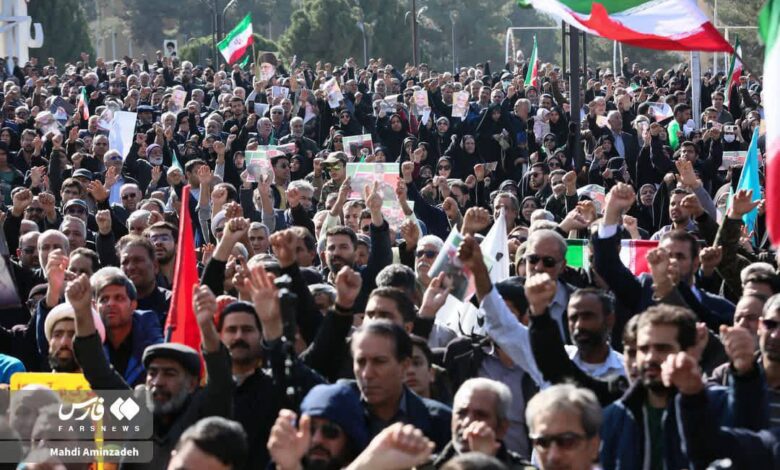
The response of the Iranian people came in the form of massive rallies across all major cities of the country, expressing support for the government and opposition to the “foreign-backed rioters.”
These massive demonstrations dispelled the myth that the people of Iran are opposed to their government. Rather, they demonstrated that a minority—supported by foreign intelligence agencies and external interests—had exploited a legitimate and peaceful assembly to advance their own agenda. It should not be lost on anyone that a gathering of a few thousand people in any country can be spun to appear as a representation of the collective conscience of the entire population.
The far larger and more disciplined marches in support of the government serve as evidence that the majority of the Iranian people stand with their government, and that their earlier grievances were primarily economic in nature—as is common in all societies worldwide—until the protests were overtaken by rioters.