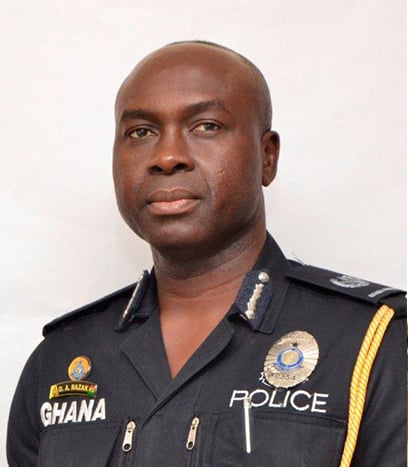
Story By: Nii Okpoti Odamtten / Muhammad Faisal Mustapha
In the often complex and delicate terrain of national security, leadership demands not only strategic foresight but also the ability to deliver results under challenging circumstances. Since assuming office as National Security Coordinator in 2025, COP Razak Osman has quietly emerged as a figure drawing increasing attention for what observers describe as a results driven and pragmatic approach to safeguarding Ghana’s national interests.
Operating in a sector frequently constrained by limited logistics and financial resources, COP Razak Osman has nonetheless steered several initiatives that have strengthened operational efficiency, improved intelligence gathering, and contributed to the protection of critical national assets.
For many analysts and citizens alike, his tenure so far represents a period of renewed strategic focus within the country’s national security architecture.
“National security leadership is often judged by outcomes rather than rhetoric, and the measurable impact of recent operations suggests a deliberate shift toward results oriented coordination.”
Before taking the helm at the National Security Council, COP Razak Osman built a reputation within Ghana’s security landscape for discipline, operational awareness, and the ability to coordinate complex multi agency initiatives.
Observers note that these attributes have become increasingly evident in his current role, where his approach appears to blend grassroots intelligence gathering, targeted enforcement operations, and strategic collaboration with other state institutions.
“Effective security leadership often lies not in visibility but in the quiet success of operations that protect the state.”
One of the most notable developments during his tenure has been the recruitment of more than 7,000 grassroots operatives nationwide, a move that security analysts say has significantly broadened the country’s intelligence reach.
The initiative, unprecedented within the history of the National Security Council, is believed to have strengthened local surveillance capabilities while improving the speed at which information flows from communities to national authorities.
Such decentralised intelligence systems are widely regarded as crucial in modern security management, particularly in countries seeking to address emerging threats ranging from organised crime to economic sabotage.
COP Razak Osman has also been credited with overseeing several operations aimed at protecting public resources and combating economic crimes.
In January 2025, a coordinated security exercise led by the National Security apparatus resulted in the recovery of multiple stolen government vehicles, preventing the state from incurring additional expenditure to replace them.
Similarly, a special task force targeting the fabrication of fake vehicle registration plates linked to the Driver and Vehicle Licensing Authority (DVLA) reportedly led to arrests and the restoration of revenue streams that had previously been lost to illegal activities.
“Safeguarding national resources is not merely a financial duty; it is a core pillar of national security.”
Another operation that captured national attention involved investigations into alleged irregularities within the National Service Secretariat.
The operation reportedly uncovered internal misconduct, leading to the arrest of suspected officers and triggering calls for deeper institutional reforms. Analysts say such actions signal a growing emphasis on accountability and internal oversight within public institutions.
In the area of economic security, COP Razak Osman is also said to have contributed to the security architecture supporting the operations of the national gold trading initiative known as GoldBod.
The initiative, which plays an important role in Ghana’s foreign exchange ecosystem, has increasingly been described by financial observers as a critical pillar in strengthening the country’s forex reserves.
Ensuring the protection of such strategic assets underscores the evolving understanding that economic stability and national security are deeply interconnected.
Another significant operation under his direction reportedly involved the rescue of Ghanaian nationals from pirate activity on the high seas, with operations coordinated through the Awutu Senya West Constituency corridor.
The operation demonstrated the expanding scope of Ghana’s security response, particularly in addressing maritime threats that increasingly affect West African coastal states.
In a development that has surprised many observers, the Logistics Unit of the National Security Council under COP Razak Osman has also supported community water access initiatives.
Close to 100 boreholes have reportedly been drilled across several communities in southern Ghana, with plans underway to extend the initiative to the northern regions.
While unconventional for a security institution, supporters argue that such initiatives contribute to community trust and cooperation an essential component of effective intelligence gathering.
Another operation credited to his leadership involved the tracking and recovery of missing electricity cables belonging to the Electricity Company of Ghana (ECG).
The discovery of these materials in obscure locations reportedly saved the state significant financial resources and prevented potential disruptions to the country’s power distribution infrastructure.
Recognising the close link between economic stability and national security, COP Razak Osman has also worked with the Ghana Revenue Authority to establish a Revenue Mobilisation Task Team.
The collaboration focuses on identifying tax evasion networks and ensuring compliance, thereby improving revenue flows into the national treasury.
While national security work often unfolds behind the scenes, the cumulative impact of these initiatives has begun to shape public perceptions of COP Razak Osman’s tenure.
Observers suggest that greater logistical support and institutional backing could further amplify the effectiveness of the initiatives already underway.
“When leadership produces measurable outcomes despite limited resources, it becomes not only commendable but worthy of stronger institutional support.”
As Ghana navigates evolving security challenges from economic crimes and institutional accountability to maritime threats the role of the National Security Coordinator remains pivotal.
For now, many observers believe COP Razak Osman’s early record signals a leadership style defined by operational focus, grassroots intelligence, and a commitment to protecting the state’s strategic interests.