Story By: Nii Okpoti Odamtten & Muhammed Faisal Mustapha.
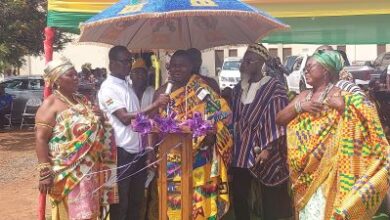
On Easter Saturday, April 4, 2026, thousands of adherents from across Ghana and the diaspora assembled for the Ogyebia Festival, a rapidly growing spiritual gathering led by Nyame Somafo Yawoh, founder of the Asomdwee Ntonton Som movement. Set against a backdrop of rhythmic chants, symbolic rituals, and vibrant cultural expression, the festival blended faith, identity, and national aspiration into a single, compelling narrative.
Held at a time of deep spiritual reflection within the Christian calendar, the event drew a diverse audience curious not only about its religious significance but also its broader philosophical and cultural claims. At the center of the gathering stood Osumafo Yawoh, a charismatic figure whose teachings continue to generate both devotion and debate within Ghana’s evolving religious landscape.
In a wide ranging address, he presented a reinterpretation of history and spirituality, asserting a direct connection between the Akan people and ancient biblical civilizations. According to his teachings, the Akan one of West Africa’s most prominent ethnolinguistic groups are descendants of a lineage he associates with the Assyrians, reimagined through a spiritual lens as bearers of divine purpose from the dawn of creation.
“This is not merely history it is identity revealed, a divine origin rediscovered,” he told the crowd.
Yawoh traced what he described as a sacred migration journey across continents, linking ancient Near Eastern traditions to settlements in West Africa, particularly present day Ghana. He cited locations such as Techiman as pivotal in this spiritual geography, presenting them as fulfillment points of what he termed a prophetic movement toward a “promised land.”
His narrative extended beyond lineage into theology. Central to his message was the concept of three divinely ordained nations Israel, Misrim, and Assyria each entrusted with a sacred spiritual center. Referencing globally recognized religious landmarks such as the Kaaba in Mecca and the Temple of Solomon in Jerusalem, he positioned Ghana as the emerging site of a “third house of God,” marking what he described as a new epoch in divine human interaction.
“The third house is not only for forgiveness it is for transformation: healing, prosperity, and restoration,” Yawoh declared, drawing applause from the assembled crowd.
The festival’s significance, however, extended beyond theology. Interwoven into the spiritual message was a bold national vision. Yawoh suggested that the rise of the Asomdwee Ntonton Som movement could contribute to Ghana’s socio economic transformation, positioning the country as a future global leader in wealth and spiritual influence.
He further outlined what he described as divine guidance regarding resource generation from the movement’s activities, proposing that portions be directed toward national development. In his view, such contributions could enhance Ghana’s economic independence and reduce reliance on foreign financial support.
“Faith must not only uplift the soul it must build the nation,” he said.
Observers note that while the movement’s teachings are unconventional and subject to scrutiny, its growing following reflects a broader trend across Africa: the emergence of new religious expressions that blend indigenous identity, reinterpretations of global faith traditions, and aspirations for national renewal.
For many participants, the Ogyebia Festival was less about doctrinal debate and more about personal transformation. Attendees described the gathering as spiritually uplifting, culturally affirming, and deeply communal.
“I came searching for clarity,” said one participant. “I leave with a sense of purpose and belonging.”
As the final rituals concluded and crowds dispersed, the festival left behind a resonance that extends beyond its immediate setting. Whether viewed as a spiritual awakening, a cultural renaissance, or a controversial reinterpretation of history, the Ogyebia Festival signals a movement that is capturing attention both within Ghana and beyond.
In a nation known for its rich religious diversity and tolerance, the rise of Asomdwee Ntonton Som adds a new dimension to an already dynamic spiritual landscape one where faith continues to shape not only personal belief, but also collective visions of identity and destiny.