Story by: Nii Okpoti Odamtten / Muhammad Faisal Mustapha….
In a decisive escalation of Ghana’s intensifying campaign against illegal mining, operatives of the National Anti-Illegal Mining Operations Secretariat (NAIMOS) have dismantled a major illegal mining enclave along the Birim River at Akurofufu in the Atiwa West District of the Eastern Region. The early morning raid, executed on Wednesday, April 29, 2026, underscores the government’s renewed urgency to protect the country’s water bodies and restore ecological integrity.
Acting on intelligence and surveillance, the NAIMOS Task Force moved swiftly at dawn, catching a large group of illegal miners estimated at over 200 actively engaged in alluvial mining operations along the riverbanks. The operation revealed extensive environmental degradation, including severe pollution and multiple diversions of the Birim River, a critical water resource in the region.
Upon sighting the advancing security personnel, the miners fled the scene in disarray, abandoning their equipment and makeshift infrastructure. The task force, maintaining operational discipline, secured the area and commenced systematic destruction of all illegal mining apparatus found on site.
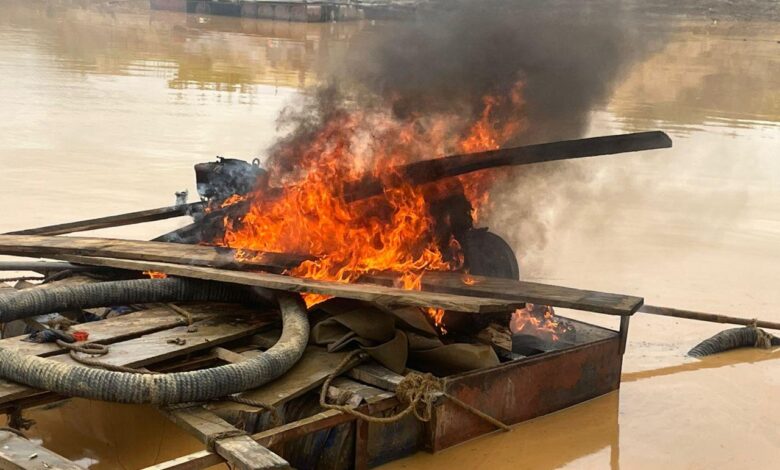
In a sweeping exercise, more than thirty (30) Chanfang machines commonly used in illegal mining operations were destroyed through controlled burning. Additionally, fifteen (15) Chanfang platforms, alongside numerous wooden structures used for gold washing, were set ablaze. Several pipe hoses and personal effects left behind by fleeing miners were also destroyed, rendering the site inoperable.
The scale of destruction highlights both the entrenched nature of illegal mining in the area and the resolve of state authorities to dismantle such operations comprehensively. Environmental analysts note that the Birim River has suffered repeated contamination from sedimentation and the use of hazardous chemicals, posing long term risks to public health and biodiversity.
Officials within NAIMOS described the operation as “strategic and necessary,” emphasizing that the focus remains not only on disruption but also on deterrence. “This is a clear signal that illegal exploitation of our natural resources will not be tolerated,” a senior operative stated under anonymity due to operational protocols.
At the policy level, the operation reflects the firm leadership and strategic direction of Hon. Emmanuel Armah Kofi Buah, whose stewardship of the Lands and Natural Resources Ministry has reinvigorated the national anti galamsey agenda. Under his guidance, NAIMOS has intensified targeted interventions across known illegal mining hotspots.
“The protection of Ghana’s water bodies is non negotiable. What we are witnessing is a coordinated national effort to reclaim our environment and secure it for future generations,” a senior ministry official affirmed.
The Minister has consistently emphasized a multi pronged approach combining enforcement, community engagement, and policy reform to combat illegal mining sustainably. His leadership has been widely credited with restoring operational coherence and political will to a fight that has long challenged successive administrations.
“This is not just enforcement; it is environmental justice in action. Every destroyed machine represents a step toward restoring the Birim River and safeguarding livelihoods downstream,” another official close to the operations noted.
Local stakeholders have also begun to express cautious optimism, as intensified enforcement appears to be curbing the most destructive practices along key waterways. However, experts warn that sustained vigilance and community cooperation will be essential to prevent re entry by illegal operators.
NAIMOS has reiterated its commitment to maintaining pressure on illegal mining networks nationwide, with particular focus on river bodies, forest reserves, and the use of toxic chemicals such as mercury. The Secretariat has also signaled that future operations will increasingly target financiers and supply chains behind the illicit trade.
As Ghana confronts the environmental and economic costs of illegal mining, operations such as the Akurofufu raid serve as a critical inflection point demonstrating that coordinated enforcement, backed by strong political leadership, can yield tangible results.