Story By: Nii Okpoti Odamtten & Muhammad Faisal Mustapha…
In a renewed demonstration of Ghana’s escalating fight against illegal mining, the National Anti Illegal Mining Operations Secretariat (NAIMOS), working closely with the Blue Water Guards, has carried out a high impact operation along the Ankobra River at Dualle in the Nzema East District, dealing a significant blow to illegal mining syndicates operating within the ecologically sensitive zone.
The carefully coordinated operation, conducted on Wednesday, May 6, 2026, between 0830hrs and 1615hrs, forms part of the Government’s broader national strategy to reclaim polluted water bodies, preserve Ghana’s forest reserves, and dismantle the growing networks behind illegal mining activities that continue to threaten the country’s environmental security.
At the center of this intensified national effort is Hon. Emmanuel Armah Kofi Buah, whose aggressive anti galamsey agenda has increasingly repositioned the Ministry of Lands and Natural Resources as a frontline institution in the defense of Ghana’s natural resources. Security analysts and environmental observers say the Ministry’s renewed operational momentum reflects a stronger political will to confront the entrenched illegal mining economy that has for years devastated major rivers across the country.
Equally instrumental in the operational successes being recorded is Colonel Dominic Buah, whose field driven enforcement strategy continues to strengthen the operational effectiveness of NAIMOS. Widely regarded among security circles as a disciplined and tactical operations leader, Colonel Buah has supervised a series of high risk anti illegal mining interventions aimed at restoring state control over vulnerable mining zones and water bodies.
The first phase of the operation targeted a large illegal mining pit situated along the Ankobra River at Dualle. Although operators had fled the site before the arrival of the taskforce, intelligence gathered on the ground revealed a disturbing evolution in the methods employed by illegal miners to evade law enforcement.
Initial inspections suggested that all mining equipment had been removed from the operational zone. However, after conducting an extensive search, the NAIMOS taskforce uncovered a sophisticated concealment strategy in which changfan machines had been buried underground to avoid detection and destruction during security sweeps.
The discovery immediately triggered an excavation exercise by the taskforce, leading to the successful retrieval and destruction of all concealed machines hidden beneath the earth.
Security experts say the incident exposes the increasing sophistication and desperation of illegal mining operators who are now adopting covert operational methods to sustain their activities despite intensified nationwide crackdowns.
“This operation demonstrates that illegal mining networks are evolving rapidly, but the state is equally determined and prepared to outmaneuver them,” a senior operational source close to the mission disclosed.
The operation later advanced to Banso, where taskforce personnel encountered a major active illegal mining enclave involving approximately 50 miners operating dangerously close to the Ankobra River.
Field observations revealed extensive environmental destruction as miners discharged untreated mining waste directly into the river system, worsening pollution levels within one of the country’s most heavily threatened water bodies.
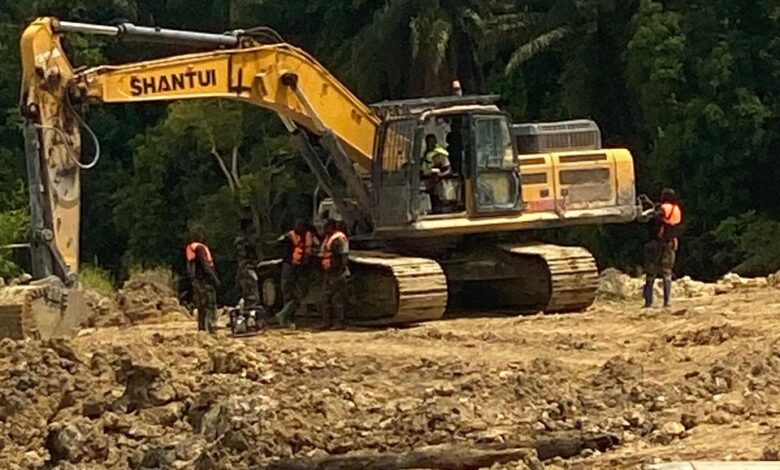
Taskforce officers identified a Shantui excavator actively supporting the illegal operation, alongside approximately ten improvised floating platforms mounted with changfan machines on a nearby pond connected to the river system.
According to operational reports, the miners were aggressively washing excavated materials within meters of the riverbank while contaminated effluents visibly flowed into the Ankobra River.
NAIMOS personnel swiftly immobilized the excavator by removing its control board and monitor before proceeding to destroy approximately 50 changfan machines discovered at the site.
The destruction exercise significantly crippled the illegal mining operation and disrupted what authorities believe may have been a coordinated supply and extraction network operating across sections of the district.
Environmental advocates say the latest operation reflects the growing effectiveness of inter agency collaboration between NAIMOS and the Blue Water Guards under the strategic direction of the Ministry of Lands and Natural Resources.
Observers further note that the current enforcement model combining intelligence led operations, rapid deployment tactics, equipment neutralization, and sustained patrols is gradually increasing pressure on illegal mining operators across several mining prone regions.
The Ankobra River, once celebrated as a critical freshwater resource for communities and livelihoods in the Western Region, has in recent years suffered severe contamination linked to illegal alluvial mining activities. Environmental scientists continue to warn that without sustained enforcement and long term ecological restoration, some affected water bodies may face irreversible damage.
Sources within the anti illegal mining campaign say the government’s latest operations are not only intended to dismantle active mining sites but also to send a strong national message that the destruction of Ghana’s water bodies and forests will no longer be tolerated.
“Protecting Ghana’s rivers is no longer merely an environmental issue; it is a national security responsibility,” an environmental policy analyst noted following the operation.
Analysts say much of the renewed operational intensity can be traced to the leadership synergy between the Ministry of Lands and Natural Resources and the operational command structure of NAIMOS.
Under the stewardship of Hon. Emmanuel Armah Kofi Buah, the Ministry has adopted a more assertive national posture toward environmental protection, while Colonel Dominic Buah’s operational leadership continues to earn recognition for translating policy directives into visible enforcement action on the ground.
The latest operation at Dualle and Banso therefore represents more than a routine security exercise; it symbolizes Ghana’s broader determination to reclaim its rivers, restore environmental integrity, and confront the economic forces fueling illegal mining across the country.
As anti galamsey operations intensify nationwide, many observers believe sustained political backing, intelligence gathering, community cooperation, and continuous field enforcement will remain critical in securing long term success in the battle to protect Ghana’s natural resources for future generations.