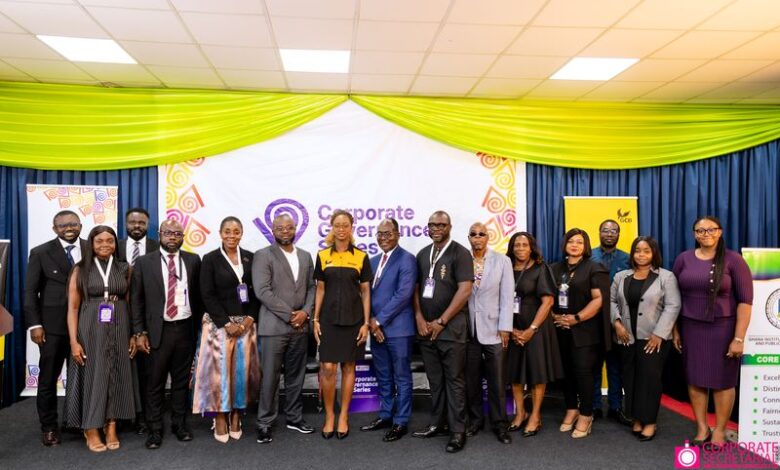
The era of the monolithic, over-60 bank board is under fire. In a provocative address that has rattled the financial establishment, John Awuah, the CEO and spokesperson for the Ghana Association of Banks, warned that institutions failing to integrate younger professionals into their “directing minds” risk becoming the “living dead” in an increasingly digital world.
Speaking at the high-stakes forum “Bank Corporate Governance & Financial Stability: The Role of Bank Boards,” held in Accra, Awuah argued that traditional boards are currently suffering from a dangerous demographic disconnect. The event, the second installment of the Corporate Governance Series, was organized by CSTS Ghana, the Institute of Directors (IoD) Ghana, and GIMPA to address the oversight failures that triggered the 2017–2019 financial crisis.
The “Big Door vs. Small Door” Analogy
Awuah’s call for action was centered on the “Youth Quake”, the necessity of bringing youthful perspectives into the boardroom to navigate AI, cryptocurrency, and virtual assets. He illustrated the cognitive gap between generations with a vivid analogy: while older directors might exit a room through a “big door,” the youth process information and “exit” digital systems through “small doors” or alternative routes that the older generation cannot fathom.
“Diversity should also be seen… in even age brackets,” Awuah asserted, noting that without this, boards fail to understand the “things happening in the air”, the intangible, cloud-based transactions that now define modern banking.
“Prophetic Capabilities” in the Age of AI
The sentiment was echoed by Sina Kamagati, Executive Head of Retail Banking at GCB Bank, who highlighted the “herculean” responsibility now placed on boards by the Cyber and Information Security Directive. Kamagati argued that modern boards must possess “prophetic capabilities” to foresee horizon risks over a two-to-three-year period.
He challenged boards to be honest about their technical vulnerabilities, suggesting that if they lack the internal expertise to oversee agentic intelligence or blockchain, they must at least co-opt youthful specialists into their deliberations. “Accept your vulnerabilities as a board,” Kamagati urged, “if you don’t have the expertise, call for help”.
Beyond “Mom and Pop” Governance
This push for youth is part of a broader “regulatory overdrive” by the Bank of Ghana to dismantle the “mom and pop” board culture of the past. Ismail Adams, Director of Banking Supervision, detailed the rigorous “fit and proper” vetting process that now ensures board members are selected for competence rather than personal connections. Adams noted that the regulator now actively seeks a “blend of competencies” that includes the digital and technical skill sets often found in younger professionals.
A Final Call for “Balanced Boards”
In his closing remarks, Dr. Alfred Mahamadu Braimah, FIoD, CEO of the Institute of Directors, reinforced the need for a “diversity equation” that moves beyond mere gender to include age and specialized skill sets. He noted that the board has transitioned from “just sitting and ticking things” to a high-level “partnership role” in institutional survival.
As the session concluded, the organizers at CSTS Ghana urged the public and industry players to stay engaged on LinkedIn and Instagram for the next edition of the Corporate Governance Series. The message to the industry was clear: to maintain financial stability, the boardroom must finally reflect the digital-first reality of the 21st century.