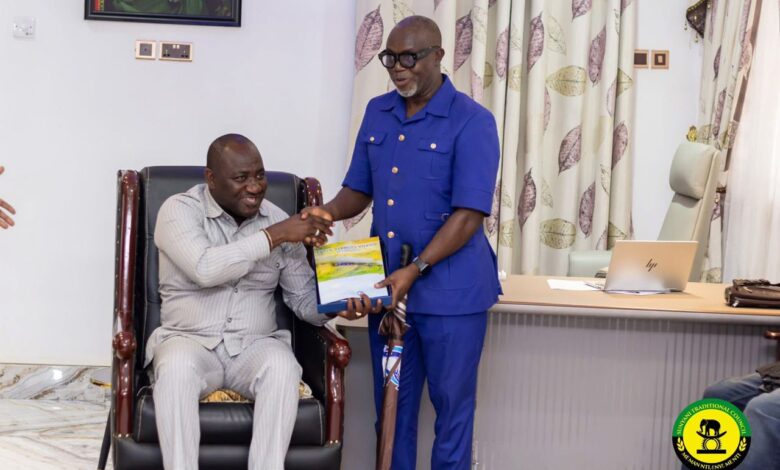
On Thursday, 9th April 2026, the Chief Executive Officer of the Ghana Meteorological Agency paid a courtesy call on the Sunyanimanhene.
Dr. Eric Asuman, Director-General of the Ghana Meteorological Agency, led the delegation. He was accompanied by Dr. Vivian Abla Kali, Deputy Director-General (Support Services); Dr. Ignatius Kwaku William, Deputy Director-General (Operations); Patricia Enninwaa Antwi, Assistant Public Relations Officer; Stanley Annan, Assistant IT Officer; Cecelia A. Aboagye, Assistant Public Relations Officer; Loretta Agbeko-Bansah, Senior Accountant; Prosper Gbedemah, Chief Driver; Issac Sai Obodai, Driver; Felix Amankwa Darkwah, Chief Meteorological Technician; Mansura Madah, Assistant Meteorologist; Emmanuel Kwesi Mehasu, Assistant Administrator; Olivia Kondo, Chief Meteorological Technician; and Rejoice Banibensu, Chief Meteorological Technician.
In his address, Dr. Eric Asuman announced that, for the first time, Ghana has launched a Climate Atlas. He explained that this important tool will help predict weather patterns over the next 50 to 100 years, enabling planners, engineers, and farmers to make informed long-term decisions.
He further stated that the core mandate of the Ghana Meteorological Agency is to provide seasonal forecasts to support the agricultural and aviation industries, as well as the general public.
The Sunyanimanhene, Odeefour Ogyeamansan Boahen Korkor II, warmly welcomed the delegation to his palace. He commended the Agency for its dedication and for the increasing accuracy of its weather predictions.
He encouraged the team to continue disseminating daily weather reports through radio and television stations. Additionally, he stressed the importance of using information centers in rural areas, noting that many local farmers rely heavily on these centers as their primary source of information.
The Sunyanimanhene also highlighted that the work of the Meteorological Agency has become even more relevant due to noticeable changes in traditional seasonal weather patterns. He advised the Agency to present weather forecasts in various local languages to ensure wider accessibility and understanding, especially among rural farming communities.
Furthermore, he recommended the use of social media platforms to share weather information, emphasizing their growing influence and reach in modern society.