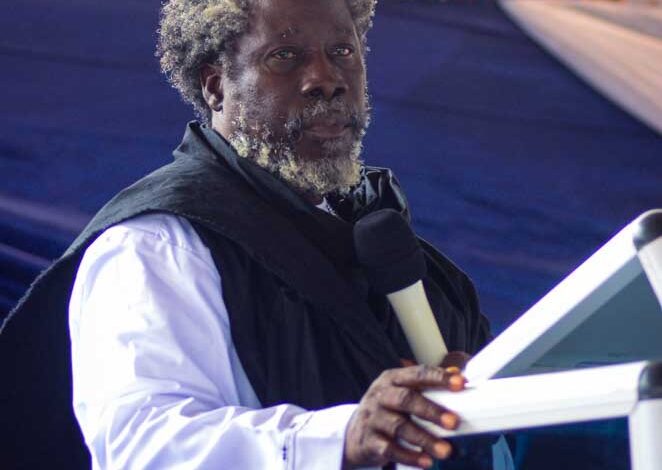
Story by: Nii Okpoti Odamtten / Muhammed Faisal Mustapha
In a quiet yet spiritually resonant corner of Ghana’s evolving religious landscape, a bold and unconventional vision is taking shape one that its founder describes as divinely ordained for the “end of days.”
Known as The Third Temple of the Most High God, and also referred to by followers as the Rabbi Temple, the movement is led by Okronkronyi Nyame Somafo Yawoh, a self described divine messenger who claims a prophetic mandate rooted in ancient Hebrew tradition.
At the heart of his message is a declaration both audacious and deeply spiritual: that the long anticipated Third Temple foretold, he says, in sacred Hebrew scriptures has been established not in Jerusalem, but in Ghana.
“Every generation receives divine direction suited for its time,” Yawoh states in an exclusive conversation.
“This is the third way of life under the Most High God a covenant renewed for humanity.”
Unlike traditional religious edifices, the Third Temple is presented not merely as a structure, but as a spiritual instrument for national transformation.
According to its founder, the Temple symbolizes the fulfillment of a divine promise: that a prophet in the spirit of Elijah would return in the last days to restore the covenant between God and humanity.
Yawoh’s teachings emphasize continuity from ancient Hebrew revelation to contemporary Ghana framing the Temple as a living bridge between sacred history and present day destiny.
Observers note that Ghana, known for its vibrant and diverse religious identity, has long been fertile ground for new expressions of faith. Yet the claim that the prophesied Third Temple now stands on Ghanaian soil introduces a narrative of global theological significance.
Central to the Temple’s spiritual practice is a symbolic walk undertaken by adherents around its premises. This act of devotion, performed through free will offerings rather than compulsion, is said to unlock seven divinely ordained benefits:
1. Forgiveness of sin
2. Healing from sickness
3. Fruitfulness and childbearing
4. Progress in life
5. Dominion
6. Prosperity
7. Victory
“It is not a ritual of obligation,” Yawoh explains.
“It is a covenant walk of faith. The offering represents devotion, not payment.”
For followers, the Temple is less about spectacle and more about spiritual alignment a conscious step into what they believe is a new divine dispensation.
In October 2025, Yawoh formally introduced his mission to Rt. Hon. Alban Sumana Kingsford Bagbin, Speaker of Parliament of Ghana, describing the meeting as part of a broader effort to inform national leadership about what he views as a transformative spiritual development.
A subsequent engagement scheduled at the presidency in November 2025 coincided with a state visit by His Excellency Frank Walter Steinmeier President of the Federal Republic of Germany. The delegation was instead received by Hon. Felix Kwakye Ofosu, who serves as presidential spokesperson.
Yawoh insists the outreach was neither partisan nor political.
“Our mission is informational, not political,” he clarifies.
“When a divine assignment concerns a nation, leadership must be aware not for endorsement, but for understanding.”
Political analysts suggest that while Ghana’s constitution upholds secular governance, the nation’s deeply spiritual social fabric often brings religious movements into dialogue with public institutions.
Complementing the Temple’s message is a spiritual text titled Tum Nwoma, translated as “The Book of Power.”
Described by its author as a divine revelation for this generation, the book is positioned as a guiding scripture for what he terms the “end of days dispensation.” He likens its role to foundational sacred texts such as the Hebrew Scriptures and the Qur’an though scholars and theologians continue to observe and assess the claim.
“Just as past generations received divine books, this generation has not been left without direction,” Yawoh asserts.
The text, followers say, offers spiritual clarity in an era marked by moral uncertainty, global instability, and existential questioning.
Whether examined through theological, sociological, or cultural lenses, the emergence of the Third Temple raises compelling questions about faith, identity, and national destiny.
Ghana’s religious ecosystem already rich with Christianity, Islam, and traditional belief systems has historically accommodated diverse spiritual expressions. The Third Temple adds a distinctly prophetic and eschatological voice to that chorus.
Supporters view it as a beacon of divine promise. Critics approach it cautiously, seeking theological grounding. Neutral observers regard it as a fascinating case study in modern African spirituality.
What remains undeniable is that the narrative is unfolding in real time.
In a world searching for certainty amid turbulence, the Temple’s founder presents his message as both warning and hope.
“History will judge whether we recognized the time of visitation,” he reflects.
“But the Temple stands as a sign that heaven has not forgotten humanity.”
As Ghana continues to shape its democratic and spiritual identity in the 21st century, the Third Temple represents more than a building it is a story of belief, conviction, and a bold claim to prophetic destiny.