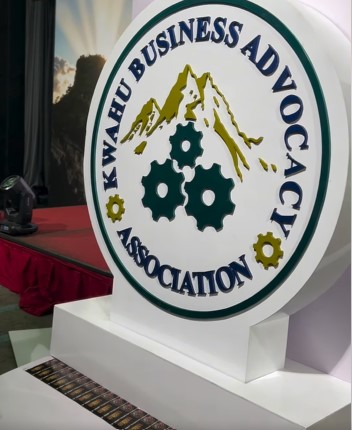
The Kwahu Business Advocacy Association (KBAA) has been officially launched, marking a significant step toward strengthening organized enterprise and promoting economic development among Kwahu businesses.
The Association, a non-governmental organization limited by guarantee, seeks to bring together key business owners and corporate executives of Kwahu origin to foster collaboration, structured engagement, and policy advocacy in support of private sector growth.
Speaking at the launch, the President of the Association, Mr. Kwabena Adjartey Danquah, described the formation of KBAA as a deliberate shift from informal networking to structured and collective engagement in a globally interconnected economy.
He noted that for generations, Kwahu entrepreneurs have built resilient businesses across various sectors, including trade, manufacturing, finance, construction, hospitality, agribusiness, textiles, pharmaceuticals, real estate, banking, energy, and communications. These contributions, he said, have played a meaningful roles in Ghana’s economic growth and job creation.
“The time has come to institutionalize that legacy,” he stated, emphasizing that modern enterprise must be organized, coordinated, and strategically positioned to engage government, regulators, financial institutions, and development partners.
Mr. Danquah explained that KBAA has been established as a non-partisan, policy-oriented platform to facilitate constructive dialogue and responsible advocacy in support of private sector development.
Mandate and Objectives
According to the leadership, the Association’s key priorities include:
- Engaging policymakers through structured and evidence-based dialogue;
- Strengthening collaboration among members to promote enterprise continuity across generations;
- Expanding access to capital and regional trade opportunities, particularly within the African Continental Free Trade Area (AfCFTA) framework;
- Encouraging innovation and competitiveness to ensure business resilience and forward-looking growth.
The Association also aims to provide a national, impartial forum for meaningful dialogue among stakeholders, including government and traditional authorities, to build initiatives that create an enabling environment for economic development in Ghana.
Minister Highlights Energy Transition as Opportunity for Enterprise
Delivering the keynote address, Minister for Trade, Agribusiness and Industry, Elizabeth Ofosu-Adjare, underscored the importance of aligning enterprise growth with global shifts in sustainability and energy transformation.
She noted that the global energy transition presents significant challenges, including the adoption of renewable energy sources, improved energy efficiency, and the advancement of a circular economy. These developments, she said, are already unfolding as governments, industries, and communities adjust to evolving environmental and economic realities.
Although complex, she stressed that the transition remains essential for long-term sustainability. More importantly, she described the move toward cleaner energy not only as a challenge but as a powerful opportunity to drive innovation, create jobs, strengthen energy security, and deliver lasting environmental benefits.
“The path forward may be demanding, but the energy transition is a necessary and transformative step toward a more resilient and sustainable future,” she stated.
The Minister further emphasized that no single company or entity defines an entire industry. Rather, industries function as interconnected systems made up of multiple stakeholders, institutions, and processes working in coordination. She encouraged businesses to recognize their role within this broader ecosystem and to collaborate strategically to shape a stronger, more competitive economic environment.
Driving Long-Term Prosperity
Mr. Danquah reiterated that KBAA’s core objective is to promote enterprise growth, job creation, and long-term prosperity through disciplined organization and shared purpose.
He highlighted the need for Kwahu businesses to come together as an association for structured economic dialogue with relevant institutions and to serve as an advisory body to members.
Membership of the Association is currently limited to Kwahu businesses and business executives, although non-Kwahu business owners may join as associate members.
The launch event brought together business leaders, corporate executives, and stakeholders who expressed optimism that the Association will deepen collaboration, strengthen advocacy, and position Kwahu enterprises more strategically within Ghana’s broader commerce and industrial development landscape.
With its formal inauguration, the Kwahu Business Advocacy Association begins its journey as a structured voice for Kwahu enterprise—aiming to unify business leaders, champion responsible advocacy, and contribute meaningfully to Ghana’s economic transformation.