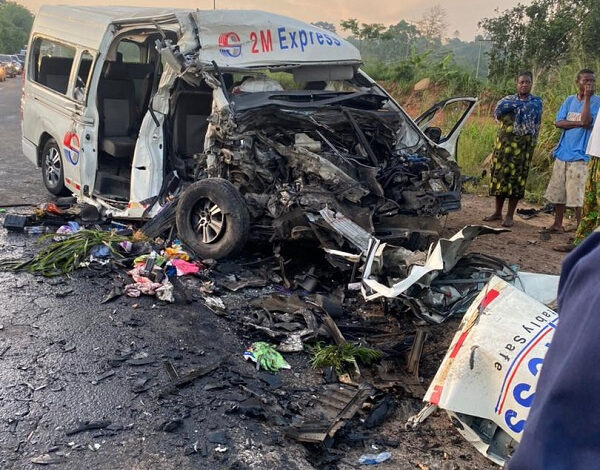
This series will attempt to delve into the contributory factors for the carnage on our roads.
Some of these factors include but not limited to driver training, driving standards, lack of due care, vehicle maintenance (a general lack of culture of maintenance), the use of straps instead of twist locks by flatbed trucks carrying containers, questionable parts and substandard mechanics, obstructions on our roads, unreasonable modifications/alterations, overloading, other mechanically propelled contraceptions on our roads (e.g. tricycles), led headlights, abuse of hazard lights, the standard of our roads, speed bumps or death bumps, the high daily/weekly ‘sales’ imposed on commercial drivers by vehicle owners, the siting of billboards and other signages, road traffic regulations and enforcement.
An extensive comparison with what pertains in the United Kingdom (UK) in respect of all the above factors is envisaged to be explored. This stems from the fact that the author lived for close to 15 years in the UK and served in the Royal Logistic Corps of Her Majesty’s Armed Forces, and upon leaving the Forces, worked extensively in the UK transport sector including Metroline and Arriva London North (contractors for Transport for London), TNT/CEVA Logistics UK and the Stobart Group (one of the largest logistics transport companies in the UK).
Part I will journey into driver training. Fact is, a well trained and committed teacher doesn’t require expensive classrooms and equipment to deliver the desired outcomes.
The only furniture in my classroom from primary one to six were the teachers’ tables and chairs. I didn’t have the luxury to use a table and chair in the classroom from P1 to P6; the bare floor was my table and chair. If we had all the expensive furniture in the world without knowledgeable, dedicated and committed teachers, I wouldn’t be writing this today.
I’m highly indebted to my current village Chief, Kanbonaaba, who was my last teacher in Middle School before I passed the Common Entrance Examinations to proceed to Secondary School, Mrs. Vivian Lariba Mahama, who recently retired as a Magistrate, but previously served as my Primary 6 teacher, and Mr. Seidu Nambe-Nyaanga, who taught me in Primary 5. These unwavering personalities are still alive!
Similarly, a V8 doesn’t drive itself. A well trained and law abiding driver (to drive according to traffic and road conditions) is required to enable one get the most out of the V8.
In the UK, two theory tests must be passed before one can proceed to the practical aspect of the driver training for a Class B license; these are the multiple-choice test and the hazard perception test. In the driving theory test, one must score at least 43 out of 50 in the multiple-choice section and 44 out of 75 in the hazard perception section. Candidates must pass both parts to be eligible for a theory test certificate.
Proof of having passed the two theory tests must be provided during registration for practical training. The various Classes of vehicle licenses in the UK are: B, C, D, and C + E
The Class B license, which is the starting point of the driver training, allows individuals to operate regular vehicles like hatchbacks, saloon cars, and estate cars. It also includes the right to drive a light van, provided it doesn’t exceed 3,500kg.
A UK category C driving license, also known as a Class II license allows an individual to drive large, rigid-body vehicles over 3,500kg up to a maximum of 32 tonnes (such vehicles are referred to as cargo trucks in Ghana). These are vehicles like bin lorries (rubbish collection trucks), tipper trucks, and large removal trucks where the trailer/body is permanently fixed to the vehicle. To get this license, one must have a full car license (category B), pass a medical exam, and pass the relevant theory and practical tests.
A UK category D license (buses), permits an individual to drive a Passenger-Carrying Vehicle (PCV) such as a bus or coach, with more than 16 passenger seats. To obtain this license, one must be at least 18 years old and hold a car license. The process includes passing a medical examination, applying for a provisional license, and passing a series of tests, including theory and hazard perception, and a practical driving test.
To get a UK category E license (articulator truck license), also known as Class I driving license, one must be at least 18 years old, hold both categories B and C licences, and pass a medical exam. The process involves obtaining provisional entitlement by passing the theory tests, complete the training and pass the practical test for the category E. These tests are not compromised in the UK!
My class B driver training took place at the Defense School of Transport (DST) South, Aldershot, and my Class C + E driver training was done at DST North, Normandy Barracks, Leconfield.
With regards to obtaining a higher category of license in Ghana to drive buses and cargo trucks and articulator trucks (killers), as they are generally referred to in the UK, one only need to be of a certain age, do a theory test and pay a fee. Thereafter, hey, one is licensed to go on the road and ‘kill’, and that is exactly what we are all witnessing on our roads. No practical training and a driving test whatsoever!
It is common to see Driving Schools in the UK training PCV and truck drivers on the roads with Learner Driver Signs on the vehicles. In the case of Ghana, is there a single Driving School dedicated to the training of PCV and truck drivers? I have never seen a bus or a truck with a Learner Sign on it. Yet, the DVLA will argue that they test applicants for PCV and Heavy Goods Vehicle Lisenses. The question is, where do they undergo the training?
One wonders how most of these commercial drivers pass the so-called theory test in Ghana, since a large number of them can’t read and write. DVLA, do you have any reasonable answers?
Part II (driving standards) loading…..
Alhassan Salifu Bawah
(son of an upright peasant farmer)