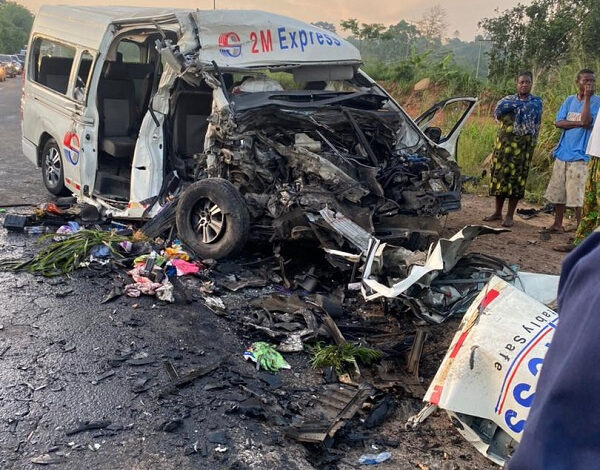
Part III concerned itself with the consequences of obstructions on our roads together with some suggested solutions.
This submission will delve into the contributions of tyres, roads and wide loads to the carnage on our roads.
Worn out tyres and inappropriate road surfaces are major contributors to accidents, since the tyre ought to have a certain level of tread depth to enable it have a grip on the road in order to maintain vehicle stability.
Motorists are therefore advised to try as much as possible to replace worn out tyres and inflate tyres to the recommended vehicle manufacturer pressure and NOT the vulcaniser’s made up pressure level.
The recommended tyre pressure is mostly found on a sticker inside the driver’s side door jamb. Other locations include the inside of the fuel filler flap, the glove box, or in the owner’s manual. For the most accurate manufacturer recommended PSI, please refer to these vehicle specific locations instead of the maximum pressure listed on the tyre sidewall.
Every component of a vehicle is made by an educated person, so please let’s take our destinies into our hands by paying attention to what these illiterate roadside mechanics do with our vehicles when we take them there for check-ups or repairs.
An over inflated tyre makes driving very uncomfortable and can easily burst, leading to an accident, while an under inflated tyre leads to excessive fuel consumption and possible damage to the tyre.
In the UK for instance, the legal minimum tyre tread depth for cars and light vans is 1.6mm and goods vehicles over 3.5 tons Gross Vehicle Weight (GVW) is 1mm across the central three-quarters of the tyre, in a continuous band around the entire circumference. Tyres must meet these requirements to avoid fines of up to £2,500 and three penalty points per tyre (accumulating 12 or more penalty points within three years in the UK triggers an automatic ‘totting-up’ driving disqualification, usually for a minimum of 6 months.
One must appear before a Magistrates’ Court, where a ban is formally imposed unless one can successfully argue “exceptional hardship” to avoid it).
This legal tyre tread depth limit in most parts of Europe and the USA is one of the reasons why we have home used tyres in Ghana, since there is nothing like legal tyre tread depth limits in Ghana (if it looks like a tyre and can be fitted into the vehicle, then it is a tyre).
Having explored the responsibilities of vehicle owners in respect of tyre condition and pressure above, road conditions and wide loads are examined next.
Maintaining the internationally accepted road standards in Ghana is the responsibility of the State.
International road lifespans generally range from 15–25 years for asphalt and 30–40 years for concrete, depending on traffic, climate and maintenance. Lower quality construction or heavy loading can significantly reduce these lifespans, requiring frequent resurfacing, thus the case of Ghana.
When the road surface is worn out, a vehicle can easily slip off the road that can lead to an accident.
The Tamale – Paga road (asphalt), was constructed somewhere in 1998 or thereabout (28 years ago). Going by international standards, this road has expired.
Similarly, the Kintampo – Tamale road project (asphalt), was undertaken by Taysec (a joint venture between Taylor Woodrow of the UK and the Social Security and National Insurance Trust (SSNIT) of Ghana, somewhere in 1988 (about 38 years ago). This road too has outlived its shelf life.
Also, the Accra – Tema Motorway (concrete), which was opened to traffic in November 1965, clocked 40 years in 2005, hence, that road should have been reconstructed about 21 years ago.
There appears to be no weight restrictions in Ghana. If a truck owner wishes to carry the whole world load at a go, he only has to visit Suame Magazine, Kumasi, and fix additional axles to his truck and off he goes.
When I see some of these trucks with multiple axles that make such trucks look like centipedes, I ask myself why the regulators are themselves the contributors to accidents on our roads and destroyers of our roads through heavy loading?
A rigid lorry (a truck without a trailer), should have a maximum of 3 axles (one at the front and two at the rear). An articulator truck unit (the head), should have a maximum of three axles (one at the front and two at the rear), while the trailer should also have a maximum of three axles.
In the UK, apart from unusual load like the transport of construction equipment such as caterpillars, the maximum permissible load for articulator trucks is forty-four tons GVW, and this relates to the articulator truck unit with three axles. For the articulator truck unit with two axles, the maximum permissible load is thirty-eight tons GVW.
In Ghana however, some articulator trucks can carry as much as over hundred tons GVW at a time. So, what do we expect? Some of the known expectations are lower road lifespans, frequent tyre bursts and breakdown of Heavy Goods Vehicles (HGVs) and reports of accidents every one minute.
A new unhealthy development in respect of articulator trucks concerns the issue of wide trailers. Some of these trailers are so wide that they block out the wing mirrors, thus making driving unsafe and thereby endangering the lives of all road users. Trucks carrying charcoal are the worst offenders when it comes to wide loads.
Fact is, if you are driving behind a vehicle and you can’t see its mirrors, it means the driver of the vehicle with the invisible mirrors can’t see you.
Driving too close to the vehicle in front, especially if the vehicle in front is a truck or a bus, will also result in one not being able to see its mirrors, hence, the driver of that vehicle in front can’t see you.
So, imagine an emergency vehicle like an ambulance, fire service or the police driving behind a fully loaded charcoal carrying vehicle or an articulator truck with a wide trailer blocking the wing mirrors, how will its driver get to know of the presence of the emergency vehicle behind it and proceed to make way for it? The siren of the emergency vehicle may not have any effect, since most of these HGVs have huge engines whose noise will most likely drown out the emergency vehicle siren.
Clearly, the failure of the regulators to effectively enforce the rules on HGVs loading has not only put the lives of all road users at risk, but has also to a greater extent, turned emergency vehicles into objects of mockery.
The government should consider introducing tyre tread depth limits in Ghana and also endeavour to keep our roads up to date at all times, and not when the roads have developed potholes and rendered unmotorable.
Alhassan Salifu Bawah
(son of an upright peasant farmer)