“When Grief Met Purpose: Andrews Kwame Perprem’s Defiant Stand for Ghana’s Forgotten Mining Communities”

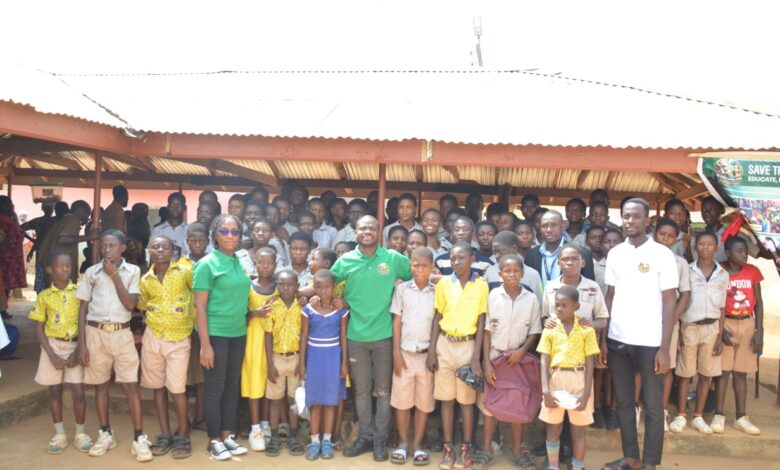
Just 24 hours after losing his father, Andrews Kwame Perprem stood before a crowd in his childhood village and did something few would have had the strength to do: he launched a movement.
Not in a conference hall in Accra. Not behind the comfort of a lectern shielded by ceremony. But on the soil that once bore witness to his hunger.
At Agyapomaa, near Kyebi in the Abuakwa South Municipality, Perprem unveiled Save the Mining Communities–Ghana (SMC-Gh)—an NGO dedicated to defending mining communities, protecting vulnerable children, promoting safer livelihoods, and advocating sustainable environmental practices in areas ravaged by illegal mining.
His voice, though steady, carried the weight of fresh grief.
“Leadership is not always convenient. Service is not always comfortable. But when the cause is greater than self, you rise, even when your heart is heavy.”
A Launch Born Out of Pain
The timing was as symbolic as it was painful. His father had passed the day before. Many expected postponements. Instead, Perprem chose tribute through action.
He described the launch as an offering to the man who, despite limited means, single-handedly raised ten children and insisted on education as their only true inheritance.
“My father would have been sad,” he told the gathering, “if education was not at the heart of this mission. Education is the only durable bridge out of generational poverty.”
In that statement lies the political philosophy underpinning SMC-Gh: that poverty in mining communities is not accidental it is structural, cyclical, and sustained by neglect.
Childhood Poverty Is More Brutal Than Any Poverty
Perprem’s speech was not a performance. It was a confession. Born and raised in Agyapomaa until age twelve, he painted a harrowing picture of childhood deprivation that silenced the crowd.
“Childhood poverty is more brutal than any form of poverty in existence,” he said. “As a child, you are vulnerable. You have no working skills, no energy, no knowledge for the labour market. You are at the mercy of the weather and the benevolence of nature.”
He spoke of going to school on an empty stomach. Of his great-grandmother, Nana Adjoa Fordjour, begging for food to cook for him. Of market days when he collected plantain scraps partially eaten by goats, washed and cooked them for survival.
He recalled walking alone into the forest at eight years old to search for wild kola nuts to sell just to buy clothes. His great-grandmother, over 100 years old, would fish to add protein to their scarce diet.
“Life was a living hell,” he said quietly. “I often wondered whether I would survive the next day.” Yet, amid hunger and humiliation, he attended school faithfully. He endured mockery. He endured disrespect. And he consistently ranked first in his class.
It is this paradox, academic excellence in the midst of starvation that fuels his outrage today.
Empty Classrooms, Full Mining Pits
Before the launch, Perprem visited local classrooms. Many were empty. He was not surprised. The children were not absent by choice. They were at galamsey sites, illegal mining pits searching for food, income, and survival.
Thirty years after his own childhood struggle, the same poverty remains entrenched in Agyapomaa and across Ghana’s mining communities. Environmental degradation has poisoned rivers. Human rights abuses persist. Schools are under-attended. Children trade books for shovels.
SMC-Gh aims to confront this reality head-on:
Protect children from exploitation in illegal mining zones.
Advocate sustainable and responsible mining practices.
Promote alternative livelihoods for families trapped in dependency on destructive extraction.
Restore dignity to communities long treated as expendable.
This is not charity. It is a political statement.
It challenges the normalization of environmental destruction.
It confronts the complacency surrounding child labor.
It demands accountability in the governance of Ghana’s natural resources.
Leadership Forged in Hardship
Perprem did not frame his childhood as a tale of victimhood. He framed it as preparation. He attributes much of his early struggle to growing up in a broken home, urging parents especially fathers to prioritize their children even when marriages fail.
“Children must not pay the price for adult conflicts,” he emphasized.
His own life changed at twelve when he moved to Accra to live with his father, who ensured his education. That intervention, he says, altered his trajectory and now compels him to intervene in the lives of others.
In choosing to proceed with the launch a day after his father’s passing, Perprem demonstrated a model of leadership rarely seen in contemporary public life: one rooted in sacrifice rather than spectacle.
The people of Agyapomaa have praised his resilience. But what they witnessed was more than resilience. It was conviction.
A Movement, Not a Moment
Save the Mining Communities–Ghana arrives at a critical time for the nation. As debates intensify over illegal mining, environmental collapse, youth unemployment, and educational inequality, SMC-Gh positions itself at the intersection of all four.
It asks uncomfortable questions:
Why do mineral-rich communities remain among the poorest?
Why must children risk death in pits to survive?
Why has generational poverty become normalized in resource-abundant regions?
And who benefits from the silence?
Perprem’s message is clear: development cannot be measured by extraction alone. It must be measured by transformation of lives, of systems, of futures.
As the sun set over Agyapomaa, the symbolism was unmistakable. A son mourning his father stood on the soil of his own childhood suffering and declared that no child should endure what he endured.
Grief did not silence him. It clarified him.
In honoring his father, Andrews Kwame Perprem may have ignited something far larger than a local initiative. He may have begun a national reckoning one that insists that leadership is service, that service demands sacrifice, and that the fight against generational poverty cannot wait for convenient timing. Because when the cause is greater than self, you rise. Even when your heart is heavy.


