Story By: Nii Okpoti Odamtten & Muhammed Faisal Mustapha….
At a time when climate change, deforestation and land degradation continue to threaten ecosystems across the globe, Ghana is positioning itself as one of Africa’s emerging leaders in environmental restoration, with an ambitious national campaign that has already seen more than 30 million trees planted within a single year.
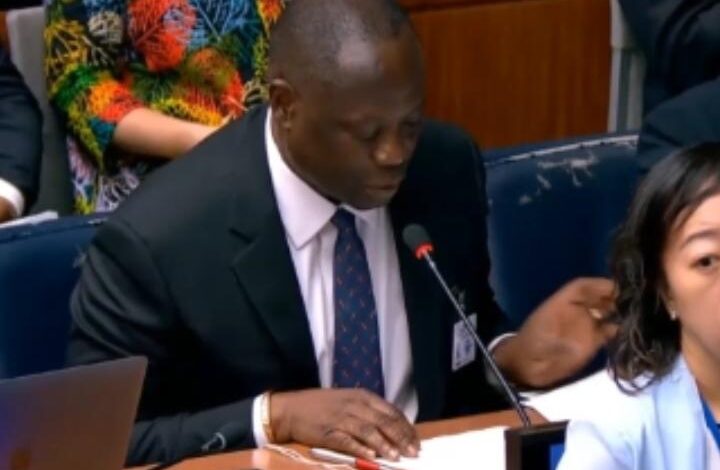
Addressing delegates at the 21st Session of the United Nations Forum on Forests (UNFF21) in New York City, Ghana’s Minister for Lands and Natural Resources, Hon. Emmanuel Armah Kofi Buah, declared that the country’s commitment to protecting its forests has moved beyond policy rhetoric into measurable national action.
The Minister said Ghana’s flagship Tree for Life (T4L) Reforestation Initiative has become one of the country’s most significant environmental interventions in recent years, mobilising citizens from every sector of society to participate in restoring degraded lands and protecting biodiversity.
According to him, the nationwide exercise brought together schools, farmers, businesses, traditional authorities and local communities in a coordinated effort that resulted in the planting of over 30 million trees across various ecological zones within the past year.
Far from slowing down, the government is now preparing for an even larger environmental mobilisation campaign. Mr. Buah announced that beginning June 2 this year, Ghana will embark on another nationwide tree planting exercise aimed at planting an additional 30 million trees during the rainy season.
The initiative, he explained, forms part of a broader national strategy to restore forest cover, strengthen climate resilience and safeguard natural resources for future generations in the face of increasing environmental pressures.
Speaking before international delegates, the Minister stressed that Ghana’s environmental agenda extends beyond reforestation alone. He noted that government is increasingly integrating tree planting into agricultural systems through the Ghana Cocoa Forest REDD+ Programme, an initiative designed to promote climate smart agroforestry practices.
The programme, he explained, is helping cocoa farmers improve yields while simultaneously protecting forest landscapes and enhancing resilience against the effects of climate change. In addition, the initiative is generating measurable carbon benefits, positioning Ghana as a key contributor to global climate mitigation efforts.
In what many observers described as another landmark achievement, Hon. Buah also announced that Ghana became the first African nation and only the second country in the world after Indonesia to issue a FLEGT licence for timber exports to the European market in August 2025.
The development signifies that all timber products exported from Ghana to Europe now carry verified proof of legal and sustainable origin, reinforcing international confidence in Ghana’s forestry governance systems and transparency mechanisms.
“That is transparency, accountability and Ghana leading by example,” the Minister declared, drawing applause from delegates attending the global forum.
Hon. Buah further revealed that government has intensified efforts to clamp down on illegal logging and illegal mining activities, both of which continue to pose severe threats to Ghana’s forests, water bodies and biodiversity reserves.
According to him, authorities are simultaneously exploring innovative financing mechanisms capable of supporting long term forest conservation, ecological restoration and sustainable land management programmes across the country.
The Minister maintained that Ghana’s forest policies remain fully aligned with the objectives of the United Nations Strategic Plan for Forests 2030, adding that environmental sustainability must remain central to global development conversations.
“Our forests are not just resources; they are our legacy,” Hon. Buah told the international gathering, as he called on development partners, environmental institutions and the global community to support Ghana’s renewed drive toward sustainable forest protection and climate resilience.
Environmental analysts say Ghana’s aggressive reforestation agenda could serve as a model for other African countries seeking practical and community driven approaches to combating climate change, restoring degraded ecosystems and balancing economic growth with environmental sustainability.