Story by Nii Okpoti Odamtten / Muhammad Faisal Mustapha…
In a decisive escalation of Ghana’s fight against illegal mining, a high stakes intelligence operation by the National Anti-Illegal Mining Operations Secretariat (NAIMOS) has exposed what authorities describe as a “well organised and potentially armed network” operating deep within the forested enclave of Kunsu Gyaenkontabuo in the Ahafo Ano South West District of the Ashanti Region.
The operation, executed in the early hours of Saturday, 18 April 2026, led to the arrest of six Chinese nationals and the seizure of a cache of weapons, ammunition, and cash evidence that is reshaping official perceptions of illegal mining, locally known as galamsey, from a largely environmental crime into a sophisticated transnational enterprise with security implications.
At the centre of the bust was a mining site along the Nyaase River, a fragile tributary of the Tano River system both critical water sources now under increasing threat from unregulated extraction activities.
According to NAIMOS officials, the operation began with the arrest of a lone suspect found actively engaged at the mining site. Under interrogation, the suspect reportedly led operatives to a nearby residence concealed within the community, where five additional suspects were apprehended.
A subsequent search of the premises yielded two pump action shotguns, 102 rounds of ammunition, assorted identification documents, mobile phones, and a black polythene bag containing GH¢60,000 in cash.
“What we are confronting is no longer just illegal mining it is organised, financed, and in some cases, armed activity that threatens both our environment and national security,” a senior NAIMOS official disclosed under condition of anonymity.
The presence of weapons has heightened concern among security agencies, pointing to the possibility that such operations may be guarded or enforced through intimidation and violence.
Beyond the arrests, the environmental cost of the operation was starkly evident. Officials described a heavily degraded landscape once productive farmlands now reduced to barren pits, and sections of the Nyaase River visibly polluted and disrupted.
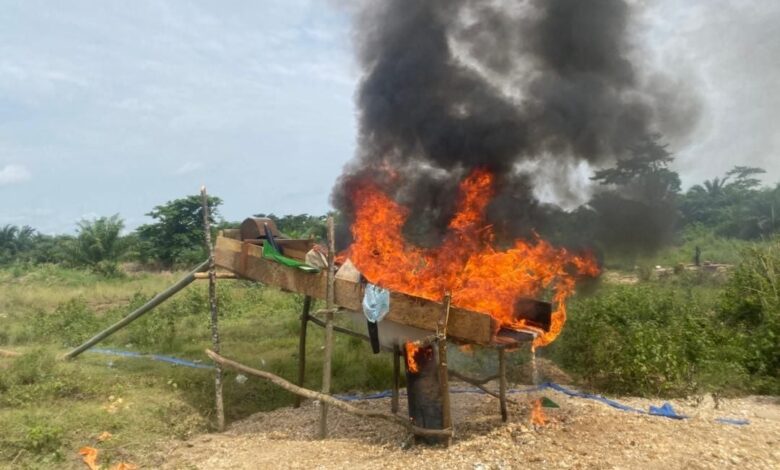
Two excavators found on site were immobilised, while a metallic gold washing platform, makeshift shelters, water pumps, hoses, and a locally fabricated mineral processing system were dismantled and destroyed.
Additionally, a wooden washing platform and a motorised tricycle commonly referred to as an “aboboyaa”were confiscated.
“The destruction we witnessed is not just ecological it is economic and generational. These are livelihoods erased and ecosystems that may take decades to recover,” another official noted.
The six suspects have since been transferred to NAIMOS headquarters for further investigation, while immigration processes have been initiated through the Ghana Immigration Service.
Ghanaian law expressly prohibits foreign nationals from participating in small scale mining, particularly in environmentally sensitive areas such as water bodies and forest reserves. The arrest of foreign operatives continues to underscore the international dimension of illegal mining in Ghana, raising complex enforcement and diplomatic challenges.
The NAIMOS Secretariat has reaffirmed its commitment to sustained, intelligence driven operations aimed at dismantling illegal mining syndicates across the country. Authorities say the latest bust forms part of a broader strategy to reclaim degraded lands, safeguard water resources, and restore public confidence in the enforcement regime.
“We will not relent. These operations will become more frequent, more targeted, and more disruptive to those who believe they can exploit Ghana’s resources with impunity,” the Secretariat stated.
As Ghana intensifies its crackdown, the operation at Kunsu Gyaenkontabuo may well signal a turning point one where illegal mining is no longer treated solely as an environmental crisis, but as a multidimensional threat requiring a coordinated national and international response.