Story by: Nii Okpoti Odamtten / Muhammad Faisal Mustapha….
In a decisive escalation of Ghana’s fight against illegal mining, the National Anti Illegal Mining Operations Secretariat (NAIMOS) has intensified enforcement operations along the Agona Nkwanta–Esiama highway corridor, dismantling a sprawling network of illicit mining activity that had brazenly taken root in full public view. The operation, carried out on Wednesday, 29 April 2026, between 1020hrs and 1530hrs, underscores a renewed national resolve under the leadership of Hon. Emmanuel Armah Kofi Buah to restore environmental integrity and public safety.
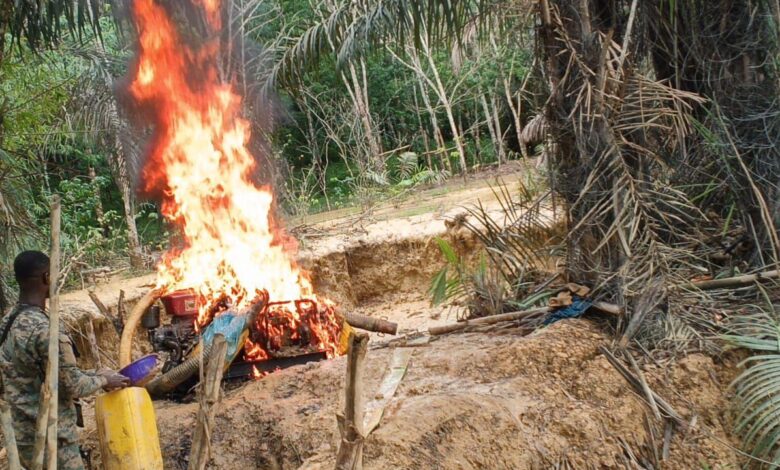
The coordinated raids revealed a troubling scene: approximately forty illegal miners operating less than 40 meters from the main highway, extracting and processing gold with little regard for the law or the consequences of their actions. Equipped with multiple changfang machines, water pumps, and an extensive network of industrial hoses, the operators were drawing vast quantities of water from nearby sources, accelerating pollution and ecological degradation at an alarming scale.
What made the situation particularly concerning was not just the environmental destruction, but the sheer audacity of the operation’s proximity to a major roadway. The highway an essential artery for commerce and daily transportation had effectively become a frontline of environmental abuse, exposing motorists and pedestrians to serious risks. The destabilized terrain, combined with open mining pits and weakened land structures, posed an imminent threat to infrastructure and human safety.
Further assessment by NAIMOS personnel confirmed extensive damage to surrounding land, including the destruction of a productive palm plantation. Once a symbol of agricultural livelihood, the area now bears the scars of unchecked exploitation its soil eroded, its vegetation stripped, and its economic value severely compromised. This transformation highlights the broader socio economic cost of illegal mining beyond immediate environmental concerns.
Acting swiftly and within its mandate, the NAIMOS taskforce dismantled and destroyed all identified illegal mining equipment on site. In total, twelve changfang machines, eight water pumping machines, four wooden gold washing platforms, multiple gold trapping carpets, and several industrial hoses were rendered unusable. Additionally, two motorbikes belonging to the miners were confiscated, signaling a zero tolerance approach to logistical support for such operations.
The operation sends a clear and unambiguous message: illegal mining activities, regardless of scale or location, will not be tolerated. It also reflects a strategic shift toward more visible and high impact enforcement, particularly in areas where illegal operators have grown increasingly bold.
“We are witnessing a dangerous level of defiance,” a senior NAIMOS operative stated during the exercise. “Operating this close to a major highway is not just illegal it is reckless. Our mission is to protect both the environment and the lives of citizens, and we will not relent.”
This intensified crackdown aligns with the broader policy direction championed by Hon. Emmanuel Armah Kofi Buah, whose leadership has reinvigorated Ghana’s anti galamsey agenda. His approach combines enforcement with advocacy, recognizing that sustainable success requires both deterrence and public awareness.
“The protection of our natural resources is not optional it is a national obligation,” the Minister emphasized in a recent policy briefing. “We must confront illegal mining with firmness, but also educate and empower communities to reject it.”
Indeed, the events along the Agona Nkwanta–Esiama corridor illustrate the urgent need for heightened public education. Despite ongoing operations, the persistence of illegal mining reflects gaps in awareness, enforcement reach, and community engagement. Addressing these gaps will be critical to achieving long term impact.
Experts argue that sustained surveillance, intelligence led operations, and inter agency collaboration must now be scaled up to match the evolving tactics of illegal miners. Equally important is the implementation of stronger deterrent measures, including stricter penalties and the disruption of supply chains that enable such activities.
As Ghana continues to navigate the complex challenge of illegal mining, operations like this serve as both a warning and a benchmark. They demonstrate what is possible when political will, operational capacity, and strategic clarity converge.
In the words of one field officer, “This is not just a fight against illegal mining it is a fight for the future of our land, our water, and our people.”